



Abstract: As the world’s largest retailer, Walmart has had a profound impact on the retail sector and even a wider range of industry participants. In recent years, Walmart’s heavy investment in RFID technology, especially its decision to force the use of RFID tags on multiple product categories, has not only set a new benchmark for the retail industry, but also triggered the industry’s deep thinking on supply chain management optimization.
Keywords: RFID
As the world’s largest retailer, Walmart has had a profound impact on the retail sector and even a wider range of industry participants. In recent years, Walmart’s heavy investment in RFID technology, especially its decision to force the use of RFID tags on multiple product categories, has not only set a new benchmark for the retail industry, but also triggered the industry’s deep thinking on supply chain management optimization.
RFID is not a high-precision technology. Since the development of radar technology in the 1940s gave birth to the theoretical basis of RFID technology, after decades of exploration and practice, RFID technology has gradually moved from the laboratory to the market. Especially after entering the 21st century, with the rapid development of technologies such as the Internet of Things, big data, cloud computing, and artificial intelligence, RFID technology has ushered in unprecedented development opportunities.
Without high-quality data provided by RFID, AI solutions may perform poorly due to low-quality input and fail to deliver the results expected by the enterprise. Therefore, the combination of RFID and AI will be an important driving force for enterprises to achieve intelligent transformation.
RFID technology also shows great potential in the field of data as a service (DaaS). As RFID systems are widely deployed in the supply chain, the visibility and operational insights they provide are becoming increasingly valuable. For manufacturers, early deployment of RFID can also open the door to monetizing the data they generate. By sharing RFID-generated data and AI-driven insights with customers, manufacturers can unlock new opportunities such as providing data as a service, strengthening customer relationships, and improving the terms of future agreements. This will bring new sources of revenue to manufacturers and enhance their competitive advantage in the market.
Walmart’s RFID strategy: from mandatory to leading
Walmart has been committed to optimizing supply chain management and improving operational efficiency through technological innovation. Traditional barcode scanning technology is inefficient and error-prone when handling large quantities of goods. RFID technology, as a contactless automatic data collection technology, has the advantages of hyperspatial identification, high efficiency, and large-capacity storage. It can track and locate goods in real time, providing a new solution for supply chain management.
In 2019, Walmart announced that it would enforce the use of RAIN RFID tags on clothing and footwear sold in its stores. This decision caused quite a stir at the time, and many suppliers expressed concerns and resistance. However, Walmart did not back down, but insisted on advancing its RFID strategy.
Subsequently, Walmart expanded this requirement to multiple categories such as toys, consumer electronics, and household goods. After successfully applying tags to these traditional product categories, it expanded the application of RAIN RFID tags to more departments, including books, crafts, media/games, and paint and hardware in the home and garden categories. Walmart plans to continue to add more categories in the future to fully realize the digitalization and intelligence of the supply chain.
Walmart’s tagging program started as a mandatory requirement, but as the industry increasingly adopts RAIN RFID technology, it has gradually become an emerging standard that other retailers can follow. Walmart worked closely with the ARC project of the Auburn University RFID Laboratory to develop performance specifications and certification processes for the RAIN RFID tags that will be used in Walmart stores. This move not only ensures the quality and performance of RFID tags, but also provides standards and processes that other retailers can learn from.
Reasons why Wal-Mart attaches importance to RFID application: from efficiency to experience
The reason why Wal-Mart attaches so much importance to the application of RFID technology is mainly based on the following reasons:
First, it improves operational efficiency. By installing RFID tags on goods and shelves, Wal-Mart can monitor inventory status in real time, including information such as the entry and exit, location, and quantity of goods. This real-time nature enables Wal-Mart to adjust orders and delivery plans in a timely manner to avoid excessive or insufficient inventory, thereby improving the accuracy and efficiency of inventory management. In addition, RFID technology can also help Wal-Mart track the flow of goods in the supply chain. Whether from suppliers to distribution centers or from distribution centers to stores, RFID tags can provide accurate location information to ensure that goods can arrive at various sales points on time. This not only improves logistics efficiency, but also reduces inventory backlogs and out-of-stock phenomena, thereby reducing operating costs.
Second, it enhances customer satisfaction. The application of RFID technology enables Wal-Mart to more accurately grasp product information, including inventory, sales, product location, etc. This helps Wal-Mart provide better customer service, such as quickly finding products and providing accurate inventory information. In addition, RFID technology can also help Wal-Mart achieve precision marketing and personalized recommendations, further improving customer satisfaction and loyalty.
The third is to strengthen supplier management. Walmart also requires its suppliers to implement RFID technology. By pushing RFID technology upstream, Walmart has achieved seamless docking with suppliers. When suppliers ship goods, they will attach RFID tags to the goods and continuously update the tag information during transportation. When the goods arrive at Walmart’s distribution center or store, the RFID reader can automatically read the tag information and compare it with the order to ensure the accuracy and completeness of the goods. This supplier management method not only improves inventory accuracy, but also simplifies the supply chain process and reduces manual intervention and error rates.
The fourth is to cope with e-commerce competition. With the rapid development of e-commerce, physical retailers are facing unprecedented competitive pressure. Walmart has optimized supply chain management and improved operational efficiency by applying RFID technology, thereby enhancing its competitiveness with e-commerce. RFID technology enables Walmart to respond more quickly to changes in market demand, provide a richer selection of goods and a more convenient shopping experience.
The fifth is to promote digital transformation. Walmart’s expansion of RFID to new product categories is part of its ongoing digital transformation. By applying RFID technology, Walmart has achieved transparency, intelligence and automation of the supply chain. This not only improves operational efficiency and customer satisfaction, but also lays a solid foundation for Walmart’s future development.
The End
Walmart’s RFID strategy has not only had a profound impact on itself, but also set a new benchmark for the entire retail industry. With Walmart’s continuous investment and application of RFID technology, more and more retailers have begun to pay attention to and try to apply this technology. Dick’s Sporting Goods also requires suppliers in most departments to use RFID tags on all incoming goods from January 1, 2025.
This not only promotes the popularization and development of RFID technology, but also promotes the digital transformation and upgrading of the entire retail industry. Retail companies are able to improve supply chain transparency and visibility, optimize inventory management, enhance customer shopping experience, strengthen anti-theft and anti-counterfeiting measures, promote digital transformation and innovation, and strengthen collaborative innovation with suppliers, so that they can better respond to market changes and challenges and improve the operational efficiency and competitiveness of enterprises.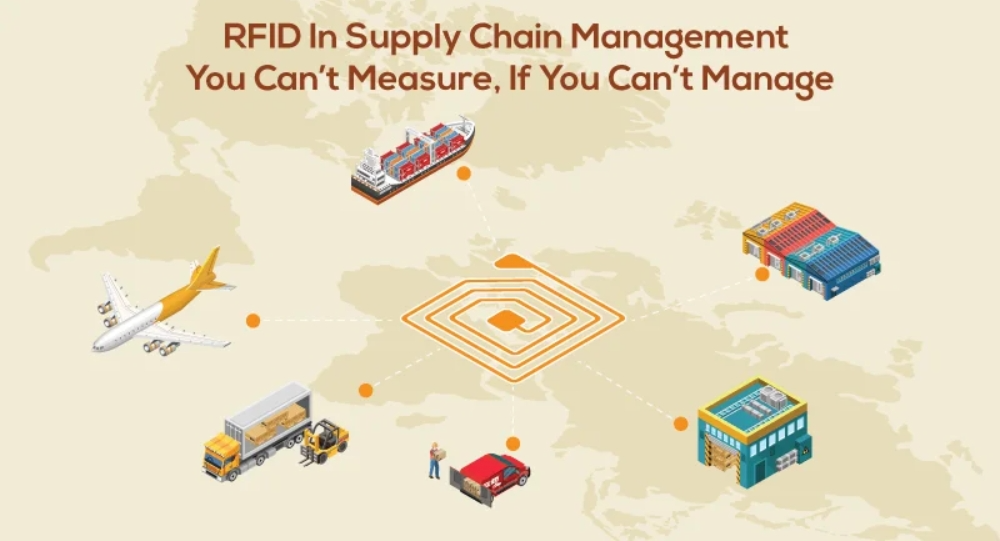
Data show that in the retail industry, RFID technology helps companies achieve better inventory management, improve inventory accuracy by more than 25%, reduce out-of-stock, loss and theft, increase the regular price sales rate by 1% to 3.5%, and increase revenue by 1.5%. RFID also provides accurate in-store inventory counts to support multi-channel delivery such as online purchases, instant delivery, and warehouse-store integration, thereby increasing flexibility in responding to supply chain shocks.
In addition, the average cost of RFID tags has dropped significantly by about 80% over the past decade, and the price of RFID readers has dropped by nearly 50%, which can greatly stimulate the interest of enterprises in applying this technology.
However, a single tree cannot make a forest. Enterprises need to combine RFID with artificial intelligence and the Internet of Things to better play the role of this technology in optimizing supply chain operations. Artificial intelligence can deeply mine and analyze the large amount of data collected by RFID, discover potential patterns and trends, and provide support for corporate decision-making. The Internet of Things technology can connect RFID with other smart devices to achieve information interconnection and interoperability, further improving the intelligence level of the supply chain.
Combining RFID, artificial intelligence and the Internet of Things, enterprises can build a more intelligent, efficient and flexible supply chain system. This system can perceive changes in the supply chain in real time, respond quickly to market demand, optimize inventory management, improve logistics efficiency, and reduce operating costs, thereby enhancing the competitiveness of enterprises.
Therefore, retail companies should keep pace with technological development, actively explore the integrated application of technologies such as RFID, artificial intelligence and the Internet of Things, and continuously promote the optimization and innovation of supply chain operations.
Post time: Feb-10-2025


