



With the continuous improvement of library service quality requirements by readers. In the library management service, improving service quality, strengthening internal management and improving work efficiency have become important work optimization. RFID technology can reduce the workload of staff, combined with RFID system to achieve automatic book circulation management. RFID can realize automatic book borrowing/returning, ensure the security of book information, and improve the circulation efficiency of book borrowing/returning. RFID technology is applied to intelligent library management.
Construction of RFID intelligent library collection management system network environment and deployment of the corresponding RFID hardware equipment. Used to identify, track, and protect all the library materials, through the RFID system to achieve book borrowing, shelving, search, inventory and other functions, greatly improve the efficiency of library materials processing RFID intelligent library management system emergence, development, maturity, wide application, completely solve the library currently need to solve the problem.
RFID is based on non-contact intelligent, automatic identification technology, it mainly through the transmission, reception, processing of radio frequency signals to identify the target object to obtain and process data, to achieve intelligent, automatic processing. After the library adopts RFID technology, the circulation of library materials will be greatly improved. RFID system can support borrowing/returning multiple books at the same time, which greatly improves the efficiency of library management and facilitates the work of staff.
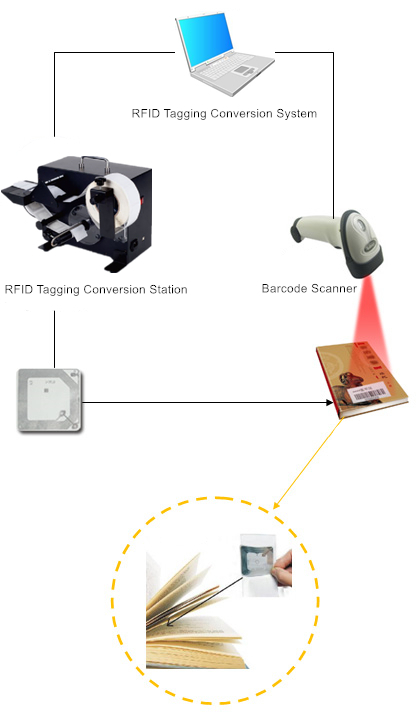
In recent years, with the maturity of RFID technology, the decline of tag prices, the acceleration of reading speed, and the improvement of security performance, RFID technology has gradually become more and more widely used. RFID technology is not only a simple bar code substitute, its systematic application will bring revolutionary influence to the whole workflow, traditional service and management mode of the library, and then trigger new business process reorganization, so that the library automation can be promoted and the service function can be further enhanced. Compared with the traditional barcode plus magnetic stripe method, its advantages are mainly manifested in the following four aspects:
1. Improve the efficiency of book borrowing and returning. Traditional bar code and magnetic stripe technology in borrowing, returning books, still need staff to open the title page of the book to find the bar code, and then scan and degaussing, borrowing efficiency is relatively low. After adopting RFID technology, RFID smart tag reader reads information in a non-contact manner, and with the help of the anti-collision function of RFID technology, multiple books can be read and identified at the same time, thus improving the borrowing efficiency and reader reception ability.
Second, the service level has been improved. Through the self-service book borrowing and returning peripheral equipment, readers can find the shelf number of books in the network system, quickly and accurately find the books they need, and handle the book borrowing and returning procedures by themselves, bringing convenience to readers. Libraries can realign the human resources saved, so that more librarians can shift from traditional management work to serving readers or other value-added services.
Third, the collection management work has been strengthened. In the open-shelf library, as a library management staff, usually need to spend a lot of energy to find random shelves, misplaced books and periodicals, and classification homing, workload and work intensity is relatively large. By inputting the shelf information of books into the RFID system, the staff can find the disordered book information in time with the help of the handheld reader in the process of daily shelf inspection, thus making the shelving and shelving work quite easy. In addition, the use of RFID technology can also simplify the book inventory work of librarians.
Fourth, strengthen the anti-theft monitoring capacity. The traditional magnetic stripe anti-theft system often appears many non-real theft situations such as false alarm, demagnetization is not clean false alarm and so on. The RFID access control system can judge whether the checked books are illegal or missing books through the integrated reader, and then judge whether to make alarm actions, reducing the rate of false positives and false positives.
The use of RFID system technology in libraries is the main development trend at present, and it has also become an important information technology foundation for the realization of intelligence, automation and efficiency in book management. RFID library management can not only track and manage book resources, but also protect the security of library books. In the management of book resources, staff members only need to operate through simple operations to quickly and efficiently manage book borrowing/returning, etc., to achieve the rapid circulation of book resources and data information.
Post time: Jun-23-2026


