



Amidst an increasingly competitive market landscape, the apparel industry is continuously optimizing its operational control processes. To shorten capital turnover cycles, it is imperative to constantly enhance production efficiency. Consequently, the industry has embraced advanced management methods and models characterized by digitalization and intelligent automation. As one of the core technologies within the Internet of Things (IoT), RFID technology finds its most extensive application in the realm of warehousing, logistics, and supply chain management. The transformative impact of adopting RFID technology in the apparel sector—manifesting as a trend toward digitalization and intelligent automation—serves as a benchmark for the sophistication and modernity of contemporary apparel warehouse management. Ultimately, RFID-enabled apparel warehousing solutions facilitate comprehensive, reliable, and fully digitized management.
Compared to other identification systems—such as barcode recognition—the primary advantage of an RFID warehouse management system lies in its capability for contactless data acquisition and the read/write functionality of its radio-frequency tags. Furthermore, its high recognition accuracy, robust adaptability, and resistance to adverse environmental factors—including light, temperature, humidity, dust, grease, and chemical reagents—make RFID warehouse management systems uniquely well-suited for deployment in the specialized and demanding environments found across various industries.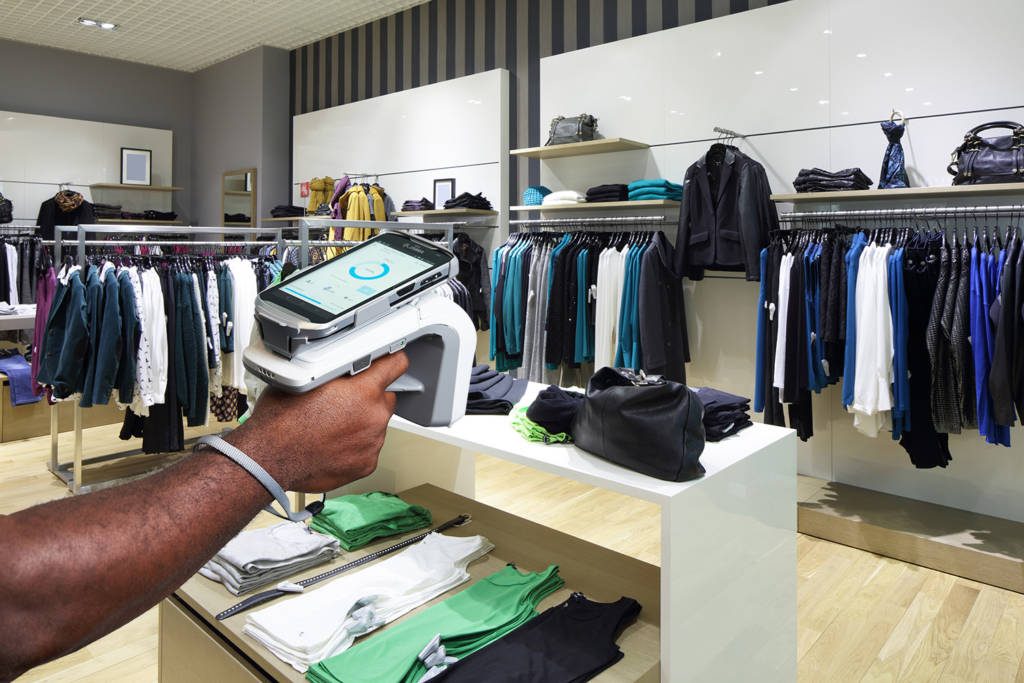

Garment warehouse management software integrates RFID technology to facilitate data collection and daily operational management. By establishing an RFID-based information management platform, it supports critical warehouse management workflows—such as inbound processing, outbound processing, and inventory counting—and demonstrates significant effectiveness in boosting the efficiency of these core business processes. This system enables automated identification, information sharing, and real-time tracking, leading to improvements in productivity, accuracy, profitability, and customer service.
**Inbound Management**
RFID technology can be utilized for data collection during inbound management in two primary ways: The first method involves using a desktop RFID encoder to input tag information, after which the tags are affixed to the corresponding goods. The second method employs handheld RFID terminals to perform both the writing and reading of RFID tags directly.
**Outbound Management**
Based on the scheduled garment picking plan, handheld RFID terminals are used to scan and collect data from the goods designated for shipment, thereby facilitating outbound management. The collected data is transmitted via a wireless local area network (WLAN) to a backend database, where it undergoes synchronization and updates.
**Inventory Counting**
The system compiles statistics on inventory quantities—including items shipped out, items currently in stock, and historical quantities searchable by date. Handheld RFID terminals enable rapid inventory counting; the collected data is then cross-referenced against the information stored in the database to facilitate verification by inventory staff.
**Inventory Information Management**
Users can monitor the status of inventory information—covering inbound records, outbound records, general inventory management, and inquiries based on various search criteria. Additionally, the system allows for the subdivision of the warehouse into specific zones or locations, enabling more precise and granular management within large-scale warehouse facilities.
**System Security**
The system features a comprehensive user login protocol wherein different personnel are assigned distinct access privileges, as configured by the system administrator. Furthermore, the system provides a “one-click” data backup and recovery function, thereby further guaranteeing the security and continuity of critical business data.
Ultra-High Frequency (UHF) RFID technology represents a new generation of automatic identification technology—following the advent of barcode technology—that is once again revolutionizing supply chain management models within the garment industry. Utilizing radio-frequency identification principles, this technology is capable of operating effectively in various harsh environments; it possesses excellent penetration capabilities, allowing it to identify items through certain physical obstructions. Moreover, it can identify goods while they are in motion and is capable of performing batch identification (scanning multiple items simultaneously). Compared to traditional barcode technology, UHF RFID offers significant and distinct advantages. The ability of RFID technology to simultaneously identify multiple target tags—even in contactless and non-line-of-sight scenarios—has emerged as a significant advantage and a core competitive strength. By embedding RFID electronic tags containing unique identity information into apparel items, RFID readers can accurately capture all associated logistics data in a single pass, thereby dramatically boosting inventory-taking efficiency. In warehouse management, the application of RFID technology enables the visual management of all operational units; this significantly reduces the time required for packaging, handling, inventory checks, and data compilation, thereby minimizing product damage, accelerating capital turnover, and substantially enhancing overall warehouse management efficiency. Furthermore, RFID technology optimizes information management across every stage of the apparel lifecycle—from production, processing, and quality inspection to warehousing, logistics, distribution, and retail sales.
Post time: May-19-2026


