



Warehouse doors open and close each time, hundreds of goods have completed the identification and data records, and all this happens only in the staff pushed a forklift naturally through a few seconds.
At 4:00 a.m., the sorting center of a large e-commerce warehouse in East China is still brightly lit. Supervisor Zhang stared at the screen jumping figures, frowning. Under the traditional bar code system, 5000 pieces of goods into the warehouse requires 6 employees to work nearly 3 hours, out of the warehouse link is more frequently wrong hair leakage. The annual loss caused by the inventory is not allowed, up to millions of dollars.
Such a scene, in the traditional warehouse management is not uncommon. Until a set of intelligent systems based on RFID technology quietly on the line, those who once let the old Zhang sleepless nights problems, began to be solved in an unexpected way.
01 The night before the change, the pain points of traditional warehousing
Late at night in the warehouse, the scanner gun “drop” sound one after another. Worker Li is a batch of clothing just arrived in the warehouse operation: unpacking, take out a piece, find the label, align the scanning, placed aside, and then repeat this action hundreds of times.
“I’m most afraid of encountering reflective, wrinkled or incorrectly positioned labels,” Li said with a bitter smile, “Sometimes it takes several times to scan a piece of merchandise before it succeeds.” The other end of the warehouse out of the warehouse area, the situation is also not optimistic. Pickers pushing carts in tens of thousands of square meters of warehouse shuttle, relying on paper documents to find the location of goods, the average picking time per single more than 15 minutes.
This is just a matter of efficiency. What gives the management more headaches is the data black hole: the system shows that there are still 500 pieces of a certain type of goods in stock, but the actual shelves are empty; customers complain that the goods they receive do not match their orders; and during the peak season, they have to pause the in-and-out operation due to the slow inventory speed. ……
Lao Zhang clearly remembers last year’s “Double 11”, due to shipping delays and misdirected shipments led to a complaint rate of up to 3.7%, the direct economic losses and brand reputation damage, so that the company’s senior management determined to seek change.
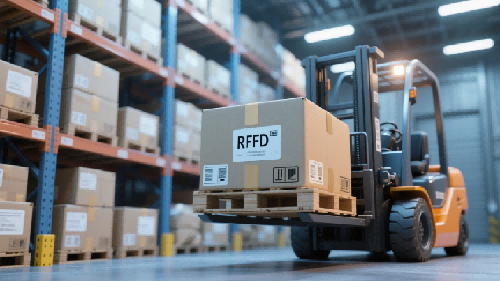
02 RFID entry, the warehouse of the “silent revolution”
change began with a number of seemingly ordinary paper tags. These tags are embedded with RFID chips and antennas that are smaller than a grain of rice, but have the incomparable capability of traditional barcodes.
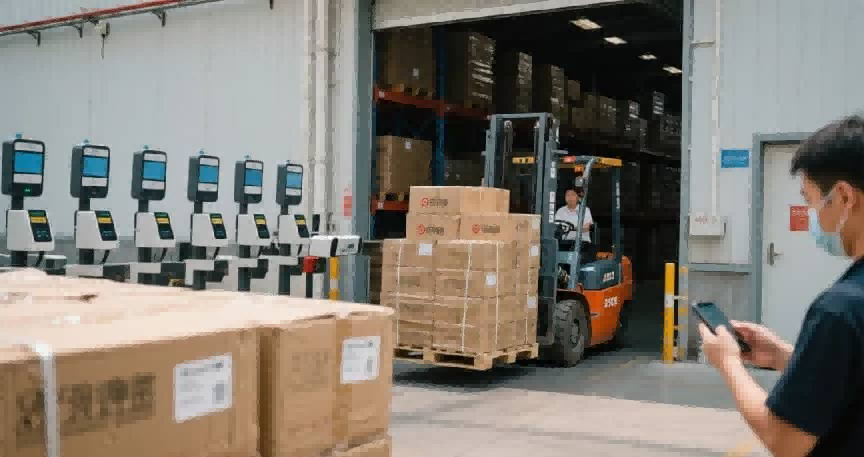
The first RFID applications were in the apparel section. The warehousing process has been redesigned: after the goods are unloaded from the truck, the whole box passes through the channel door equipped with RFID readers, and in less than 2 seconds, the information of 200 pieces of clothing in the box has all been entered into the system. No need to open the box, no need to scan piece by piece, no need to adjust the angle of the tag.
“We couldn’t believe it the first time it was demonstrated.” Lao Zhang recalled, “A pallet of goods, pushed through that door, the numbers on the computer screen brushed up.” Once required 40 minutes to complete the warehousing operation, now shortened to less than 3 minutes.
The secret of RFID is its non-contact, batch-reading capability. Traditional bar codes require optical line-of-sight alignment and can only scan one at a time; while RFID readers can simultaneously identify dozens or even hundreds of tags, regardless of whether or not the tag is covered, regardless of which direction it is facing.
03 The logic of “second” access
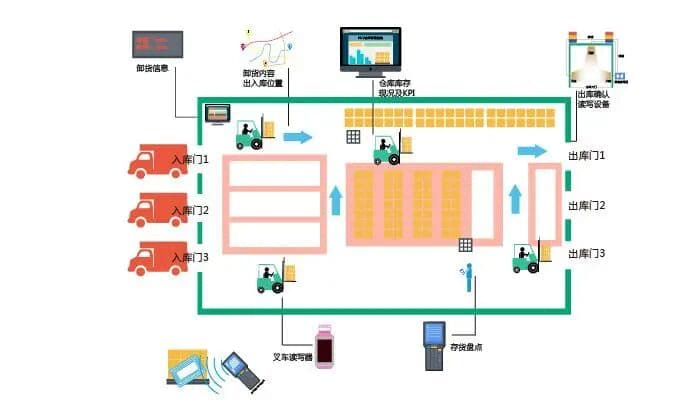
The real breakthrough came when the system went fully online. Each key node of the warehouse was reconfigured to form a seamless data flow.
In the warehouse area, goods are labeled with RFID tags at the same time they are unloaded, which is equivalent to a “digital ID” for each piece of merchandise. Through the channel door, the reader instantly captures all the label information, automatically completes the system registration, storage space allocation. Previously require manual judgment of goods classification, data entry links, now all automatically completed by the system.
The management of the warehouse has undergone a fundamental change. Each shelf is installed with RFID read-write equipment, and any movement of goods will be recorded in real time. The PDA in the hands of the picker no longer needs to be scanned frequently, just close to the target shelf, the system will automatically light up to prompt the exact location and the required quantity.
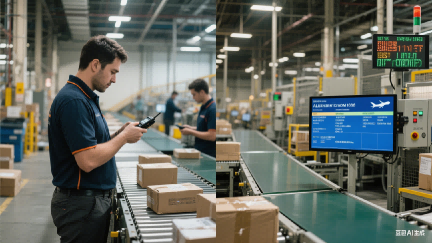
The most obvious change is in the outbound process. The packaged goods are transported to the loading area via conveyor belt, and the RFID readers on the way automatically check the order information, and any mismatched goods will be automatically sorted out. A final full-vehicle scan before loading ensures that every item sent out is exactly the same as the order.
04 The Real Benefits Behind the Data
Three months later, the finance department delivered a benefits report that surprised everyone. The inventory accuracy rate increased from 87% to 99.99%, which means that the loss caused by inaccurate inventory was reduced by more than 90%.
The improvement in the efficiency of inbound and outbound inventory is even more amazing. The maximum processing capacity for a single day was raised from 50,000 pieces to 150,000 pieces, while labor costs were instead reduced by 30% – some of the employees in scanning positions were transferred to customer service and quality control, which are more people-demanding.
“Last year’s ‘Double Eleven’, we created a record of zero wrong shipments.” Lao Zhang’s tone of voice with pride, “the customer complaint rate dropped by 85%, which is money can not buy the reputation.”
RFID brings not only efficiency, but also a management model of innovation. Real-time, accurate inventory data, so that enterprises can implement more sophisticated inventory management, reduce the risk of slow-moving; complete traceability data for product quality control and after-sales service provides strong support.
05 Challenges and solutions in practice
Any technology landing will not be smooth sailing. RFID system in the initial stage also encountered a variety of challenges: the impact of metal shelves on the signal, liquid goods on the absorption of electromagnetic waves, dense stacking of missed readings ……
For metal environments, the technical team developed special anti-metal tags, which ensure stable reading even on metal surfaces through special antenna design and isolation materials. For high-density stacking scenarios, the read rate is increased to more than 99.9% by adjusting reader power, optimizing antenna layout, and adopting anti-collision algorithms.
“The most difficult thing is to change people’s habits.” Lao Zhang confessed, “Some old employees are used to the feel of the scanner gun and are resistant to the new system.” To this end, the warehouse carried out several rounds of training to allow employees to experience the convenience of RFID – no longer need to scan repeatedly, no longer need to climb high to align the tags, the work has become easy and efficient.
06 From Automation to Intelligence
In today’s warehouses, AGV carts shuttle along predetermined routes, and they navigate and locate themselves through RFID landmarks; robotic arms automatically sort goods, relying on RFID information to identify different categories of commodities; and in temperature-controlled zones, RFID tags with temperature sensors monitor environmental changes in real time.
The massive data generated by the RFID system is being further mined for value. By analyzing the heat map of commodity flow, the warehouse optimizes the layout of the goods, placing high-frequency commodities in a more accessible location; by counting the operating time of each link, hidden bottlenecks in the process have been discovered.
“Previously we managed goods, now we manage data flow.” Lao Zhang summarizes it this way, “Every piece of merchandise, from the time it enters the warehouse to the time it leaves, has left a complete digital trajectory in the system. Based on this data, we can predict demand, optimize stocking, and deploy resources in advance.”
When asked about the biggest change brought about by RFID, the old Zhang did not mention those eye-catching data, but spoke of such a detail: in the past, every inventory day, the warehouse must be overnight operation, staff exhaustion; and now, inventory can be quietly completed during normal working hours – push the reader in the shelves between the walk around, all the data has been Synchronized update to the cloud.
At the end of the warehouse, the last batch of “Double Eleven” orders are passing through the exit channel. Under the flashing green light of the reader, the information of more than 50 pieces of goods per second is captured, checked and confirmed. The whole process is quiet, smooth, almost unnoticeable.
This change, which began with a small label, has redefined the basic logic of warehouse operations. When each piece of merchandise can be real-time perception, accurate positioning, full traceability, warehousing is no longer a passive storage space, but the node of the supply chain in the flow of wisdom.
Post time: Feb-09-2026


