



Walk into the warehouse of any major apparel retailer and you’ll likely see employees manually scanning barcodes on every garment. In the age of e-commerce and omnichannel retail, this traditional approach is becoming less and less applicable. According to retail research data, inaccurate inventory costs the global retail industry approximately $450 billion per year.
At this time, RFID (radio frequency identification) technology has emerged and is revolutionizing inventory management in the apparel and footwear industry. From Zara to Uniqlo, from Nike to Decathlon, many leading brands are embracing this “silent revolution”. This article will explore how RFID is reshaping the supply chain and unlocking new business value.
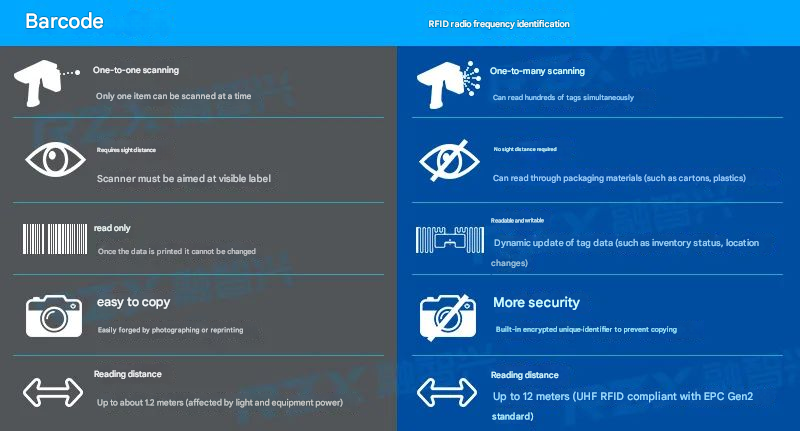
Part I: RFID vs. Traditional Barcodes – A Technological Leap
1.1 Efficiency Breakthrough: From Single-Piece Scanning to Batch Reading.
Traditional barcodes process goods one by one; RFID enables contactless, batch identification. For example, when a whole truckload of clothing passes through RFID access control, it only takes a few seconds to complete the scan, which increases efficiency by up to 80 times.
1.2 Accuracy Revolution: From 95% to 99.9%+.
Harvard Business School research shows that the average accuracy of barcode-based inventory is 95%, which means that 5 out of every 100 items may be recorded incorrectly. With RFID, the accuracy rate can reach more than 99.9%, which is particularly important for luxury brands – because the misplacement of a high-value item can result in significant losses.
1.3 Real-time Visualization: From Delay to Instant Synchronization.
Traditional barcode systems often have data delays (such as a 3-day delay in inventory updates). RFID technology enables real-time synchronization, ensuring accurate and timely inventory data during high-demand periods such as Black Friday.
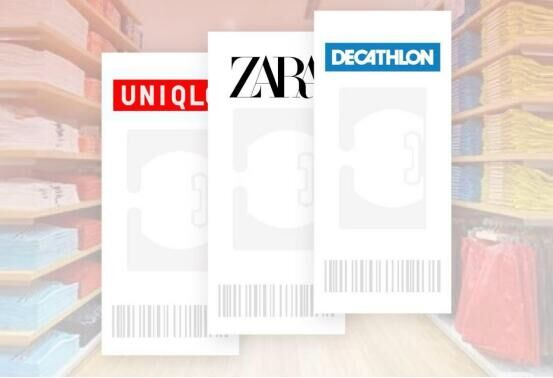
Part II: End-to-end application of RFID in the supply chain
2.1 Manufacturing link: anti-counterfeiting and traceability.
Brands such as Adidas embed RFID tags in the production stage to achieve the following functions: ① The entire manufacturing process is traceable ② Anti-counterfeiting verification (consumers can scan the label to confirm the authenticity through their mobile phones).
2.2 Warehousing and logistics: intelligent automation.
In JD Logistics’ clothing warehouse, RFID technology has brought significant improvements:① Receiving efficiency increased by 70% (from 4 hours to 1.2 hours) ② Picking accuracy reached 99.99% (errors reduced by 90%) ③ Delivery verification time reduced by 90% (from 30 minutes to 3 minutes).
2.3 Store experience: the future trend of retail.
The RFID “magic mirror” launched by Uniqlo can achieve the following functions: ① Automatically identify the goods in the hands of customers ② Display real-time inventory, dressing suggestions and promotional information ③ In pilot stores, customer conversion rate increased by 15%.
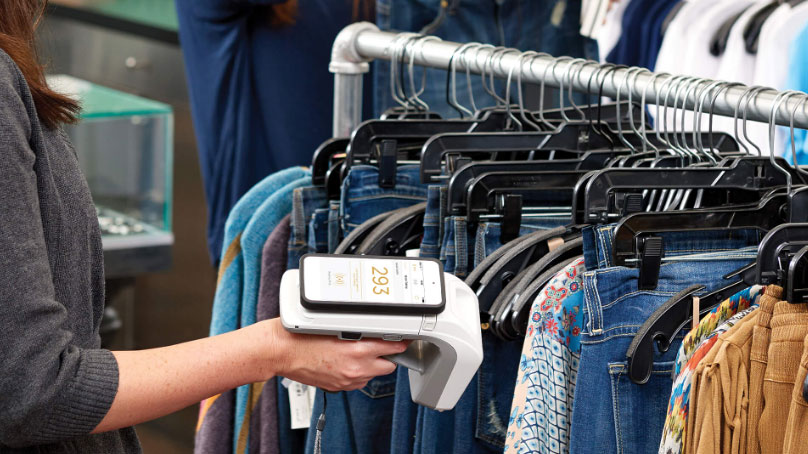
Part III: Quantifiable Business Results
3.1 Significant financial benefits.
After introducing RFID, a global fast fashion brand achieved the following results: ①Increase in inventory turnover by 22% ②Reduction in labor costs by 18% ③Reduction in out-of-stock situations by 35% ④Increase in sales by 9.3%.
3.2 Strategic advantages.
In addition to cost savings, RFID also brings the following long-term value: ①Eliminate the “ghost inventory” problem (there is inventory on the books, but not in the real thing) ②Improve omni-channel fulfillment capabilities ③Achieve data-driven supply chain decisions ④Enhance the brand’s innovative image in the market.

Conclusion: RFID is more than just an inventory management tool – it is reshaping the retail industry’s operating model. As a CEO of a retail technology company said, “In another decade, clothing brands that have not deployed RFID will be as outdated as using an abacus to do accounting.” For companies that are still waiting, the question is no longer “whether to adopt”, but: ① How fast should we follow this technological change? ② Are we willing to bear the cost of missing the opportunity? Companies that first deployed RFID have begun to reap the benefits; while companies that are slow to act may be irreversibly left behind by the era of smart retail.
Post time: Jun-16-2025


