



Abstract
As jewelry retailers adopt digital refined management, traditional barcodes and manual stocktaking struggle with frequent checks, inventory accuracy and high-value goods security. RFID, with contactless multi-tag reading and unique item ID, powers jewelry digitalization.
Jewelry is high-value, small, metallic, with many SKUs and frequent trials & transfers. Jewelry RFID systems require stable performance in complex RF environments alongside high reading efficiency.
Thus, integrating inventory counting and entrance anti-theft into one RFID identification system has become a mainstream solution.
1 Technical Logic of RFID Jewelry Inventory
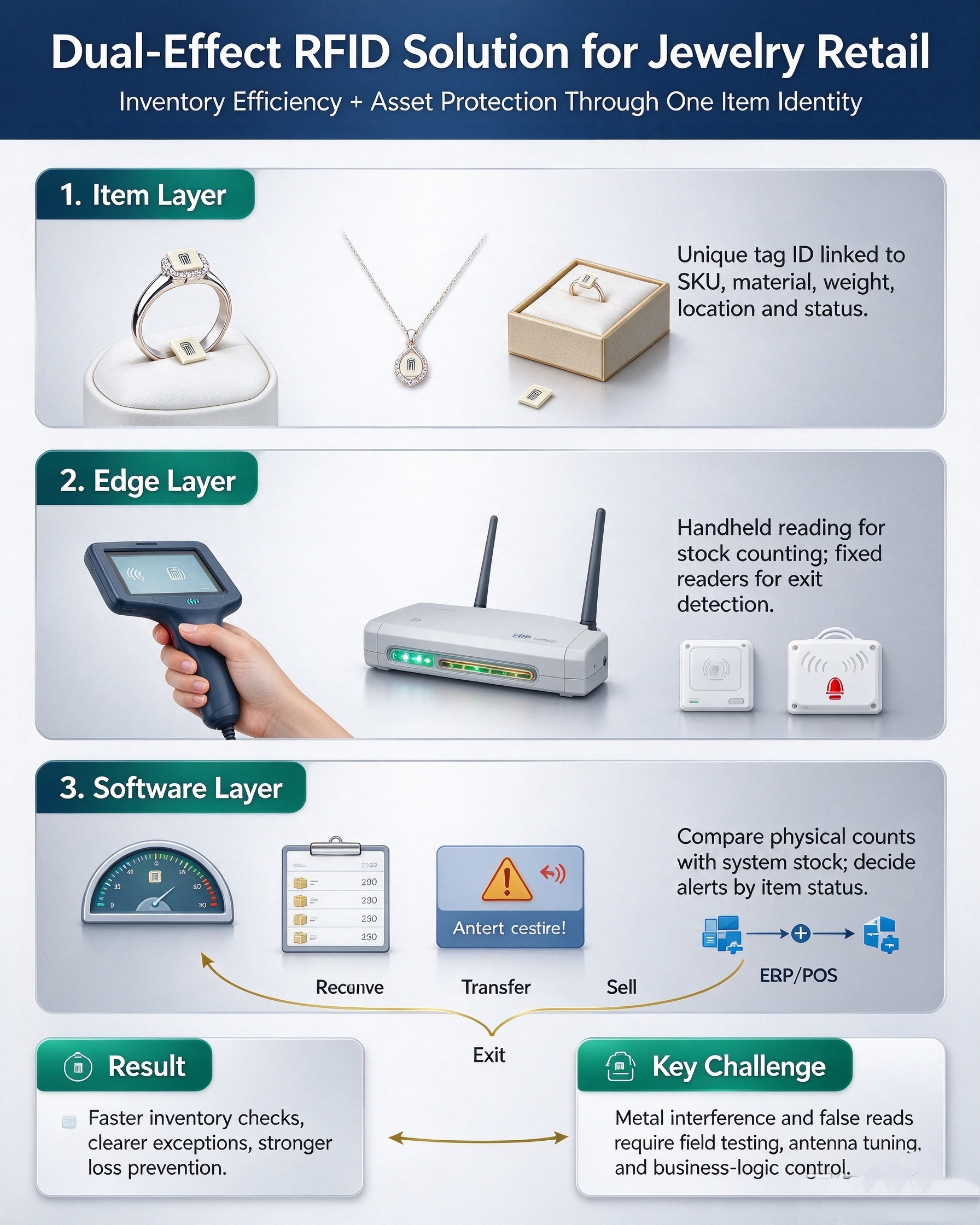
Each jewelry item is attached with an RFID tag linked to backend data including SKU, name, category, material, weight, store, counter and stock status. Staff use RFID handheld readers to capture tags in range and upload data. Unlike one-by-one barcode scanning, RFID supports multi-tag reading without precise optical alignment to speed up stocktaking. The backend compares physical counts with system inventory to generate surplus, shortage and exception reports.
2 From Inventory Identification to Anti-theft Alert
RFID anti-theft sets detection zones at exits. The system checks item status once a tag is detected. Sold/authorized items pass normally; items still in stock or on display trigger audio-visual alarms and notify management terminals. Its core combines tag reading and item status judgement. Antenna solutions can be customized: concealed ceiling or buried antennas for high-end stores. Antenna quantity, position and transmitting power are tuned according to doorway width and traffic routes.
3 Technical Challenges of Jewelry RFID
Metal interference is the primary obstacle. Jewelry and counters contain abundant metal, causing RF signal reflection and attenuation that disrupt tag reading. Settings for apparel RFID cannot be copied directly. Tag packaging, mounting position, metal clearance and antenna layout all affect reading performance. Longer detection range is not always desirable. Overwide coverage causes false alerts by detecting items not leaving the store. Power adjustment, antenna arrangement and algorithms are adopted to limit reading boundary and reduce cross-reading.
4 Integrated System Architecture for Anti-theft & Inventory
The dual-function system consists of RFID tags, handheld readers, fixed readers, antennas, alarms, middleware and management platform. APIs enable connection with existing ERP, WMS and POS systems. One unique tag ID covers receiving, counter stocktaking, transfer, sales and checkout to eliminate data silos. After sales, POS updates item status in RFID system, which triggers corresponding rules at exit gates.
5 From Hardware Deployment to Data Utilization
The long-term value lies in item-level data. Unique identification delivers fine-grained real-time inventory for headquarters to support replenishment and stock allocation. Smart counters and zone detection can capture item pick-and-place records and manage displays subject to system and site conditions.
6 On-site Validation for Project Rollout
Jewelry RFID is highly scenario-dependent. Proof-of-concept and field tests are required before mass deployment. Tests cover tag read rate for various materials, multi-angle performance, multi-tag stability, exit detection boundary, false reading and system linkage. Acceptance criteria shall follow real store workflows instead of lab-only parameters.
Conclusion
Jewelry RFID evolves from standalone fast stocktaking into integrated inventory, anti-theft and full-lifecycle asset management. Unique digital identities enable efficient handheld stocktaking and fixed-point abnormal flow alerts. RFID is neither a standalone anti-theft tool nor simple hardware replacement. Only integration of tags, RF design, readers, software and business workflows delivers the dual benefits of inventory efficiency and asset security.
Key Points
- RFID tags bind jewelry data; handheld readers realize fast multi-tag inventory and stock discrepancy analysis
- Exit RFID detection judges item status and triggers alarms; customizable concealed antenna layout
- Metal interference and cross-reading are main technical hurdles; RF parameters need field tuning
- Integrated system connects ERP/POS; single tag tracks the whole item lifecycle
- Item-level data supports replenishment, transfer and display management
- Field verification is mandatory; acceptance metrics based on real store scenarios
- RFID integrates hardware, radio frequency design and business processes for both inventory efficiency and asset safety
Post time: Sep-29-2026


