



I. Current Industry Landscape
As market competition intensifies, enhancing production efficiency and reducing operational costs have become critical imperatives for enterprises. Currently, most warehouse management systems rely on tools such as barcode labels or manually processed paper documents to facilitate warehouse operations. However, the inherent limitations of barcodes—such as their susceptibility to counterfeiting, poor resistance to dirt and moisture, and complex operational procedures—combined with the complexities involved in manually completing documentation, make these methods highly prone to human error and material loss. Consequently, warehouse management practices within the domestic sector continue to suffer from significant shortcomings.
II. Challenges Currently Being Faced
Today, warehouse management within grain storage facilities and related enterprises still largely relies on non-automated, paper-based record-keeping systems to track the inflow and outflow of grain. The specific challenges encountered include:
(1) **Diversity of Grain Types:** Given the wide variety of grain types, it is common for different categories of grain to be received into storage simultaneously. Similarly, outbound shipments often require individual orders to comprise multiple packages of various grain types. Under these circumstances, relying on manual methods to count incoming and outgoing stock results in an extremely high error rate.
(2) **Inventory Auditing:** During inventory audits, relying on manual verification to cross-check stock quantities leads to similarly high error rates, making it difficult to ensure that physical stock levels accurately match the corresponding ledger records.
(3) **Human Factor Uncertainty:** The inherent uncertainties associated with human involvement result in low operational efficiency and constitute a significant waste of human resources. Furthermore, as grain volumes increase and the frequency of inbound and outbound movements rises sharply, this traditional management model exerts a severe negative impact on overall operational efficiency.
(4) **Lack of Real-time Data:** Traditional management methods prevent grain warehouses from updating inbound/outbound and inventory audit data in real-time, thereby hindering the effective sharing of information resources within the organization.
In response to these complex management challenges within the grain storage sector, SCO has developed a solution—tailored to specific operational realities and requirements—that leverages Radio-Frequency Identification (RFID) technology. This solution is designed to streamline inbound/outbound processing, facilitate accurate inventory auditing, and enable rapid stock retrieval, thereby achieving highly efficient and precise management of grain storage operations.
III. The RFID-Based High-Efficiency Management Solution
1. Inbound Management
The Inbound Management module is primarily responsible for the automated registration of various flour products as they enter the warehouse through designated receiving channels, as well as for facilitating other auxiliary management tasks related to the receiving process. Recommended Solution for Automated Inbound Registration: RFID Vertical Warehouse Portal
(1) Product Introduction
Supports multi-tag reading and utilizes an infrared-triggered reading mode. It features integrated sound and light alarms and supports headcount statistics for personnel entering and exiting the area. The device supports Ethernet communication and can be expanded to accommodate various other communication methods, such as Wi-Fi and 4G.
(2) Product Features
1. Exceptional multi-tag reading capability, with extremely low rates of missed reads and misreads.
2. Specially designed antennas ensure precise coverage of the portal area with no blind spots.
3. Built-in alarm light and buzzer.
4. The RFID security portals can be spaced further apart—up to 3–4 meters—allowing for wider aisle clearance.
5. Equipped with a 21.5-inch capacitive touchscreen that displays real-time inbound/outbound information and quantities, while also tracking the number of people entering and exiting the area.
(3) Operational Workflow
When flour—to which electronic tags have been affixed—is ready to enter the warehouse via the inbound conveyor system, it passes through the RFID warehouse portal installed at the conveyor’s exit point. At this moment, the RFID portal automatically performs an RFID scan to identify the flour. Once identification is complete, the flour’s information (such as flour type) is displayed on the portal’s touchscreen interface, accompanied by an audible alert. Simultaneously, the portal transmits this inbound data to the backend database for updating. At this point, the automated registration of the flour’s entry into the warehouse is complete.
Additionally, handheld RFID readers deployed on-site can be utilized to facilitate other auxiliary management tasks related to inbound operations—for instance, querying the historical inbound records for a specific type of flour, or automatically generating and printing inbound record reports for a specified date.
2. Outbound Management
Outbound management primarily involves accurately and automatically registering the departure of various types of flour required by customers—based on the specific details of their pickup orders—as well as handling other auxiliary management tasks.
Recommended Solution for Automated Outbound Registration: RFID Portal Gate
(1) Product Introduction
Designed for scenarios involving the batch-processing of inbound or outbound shipments, this device enables rapid, high-volume reading and identification management. The system utilizes Ultra-High Frequency (UHF) RFID technology to identify the RFID tags attached to items, thereby significantly reducing labor costs, shortening the time required for inbound/outbound processing, and boosting overall operational efficiency.
Its large physical dimensions are designed to accommodate a wide variety of cage carts and shelving trolleys. The device utilizes a PLC to automate the opening and closing of the roller shutter, enabling a “closed-loop” reading mode that prevents the accidental reading of surrounding tags.
(2) Product Features
1. Features a 17-inch industrial all-in-one touchscreen PC; the default configuration runs on the Windows operating system, with Android available as an option.
2. The industrial touchscreen unit is equipped with a retractable keyboard and mouse, facilitating convenient real-time interactive data entry and operation.
3. Includes two USB ports, allowing for the easy import and export of relevant data, as well as the connection of external peripherals such as a keyboard.
4. A top-mounted status indicator light displays three distinct states—Standby, Running, and Error—providing a real-time visual representation of the device’s operational status.
5. Functional status indicators—mirroring the Standby, Running, and Error states—are positioned along the upper edge of the entrance, allowing for the device’s status to be easily monitored from various angles.
6. The device is equipped with an emergency stop button, enabling the immediate shutdown of the unit and the braking of the roller shutter motor in the event of an emergency, thereby facilitating prompt intervention.
7. Features a built-in wide-angle surveillance camera, allowing operators to monitor the internal operational status of the channel unit in real-time via the external industrial control interface.
8. The sides of the channel unit feature a stepped, anti-collision design to prevent carts from colliding with the internal antennas or the inner walls of the unit during entry.
9. The anti-collision components are constructed from durable nylon material and are fitted with dual-color warning strips for enhanced visibility. …with a striking appearance;
10. Equipped with an electric, low-noise rolling shutter door featuring a high-speed motor for rapid opening and closing;
11. Utilizes a specially designed shielding shutter curtain to prevent signal leakage from the portal reader, thereby eliminating the occurrence of tag cross-reading;
12. Features two sets of foreign object detection sensors that monitor for obstructions in real-time, working in conjunction with the rolling shutter to prevent pinching and product damage;
13. Employs a PLC for automated control, enabling automatic opening and closing of the rolling shutter, as well as door-closure detection to prevent accidental reading of warehouse tags (the shutter opening/closing time can be controlled within 3 seconds);
14. Includes six built-in cargo sensors that detect the real-time position of goods, triggering the PLC to execute corresponding operations;
15. Powered by a high-performance UHF module capable of rapidly identifying batches of over 800 products;
16. Features entrance lighting indicators and an optional LED inventory display screen at the portal entrance to show the total inventory count in real-time;
17. Supports two external communication methods—Wi-Fi and Ethernet—offering flexible connectivity options for various application scenarios;
18. Equipped with six ultra-quiet casters, each with a load-bearing capacity exceeding 150 kg and adjustable height; the adjustable height feature facilitates easy maneuvering and secure positioning of the unit;
19. Features a concealed design with an aesthetically pleasing appearance and no visible external metal screws; the high degree of equipment integration enhances the product’s premium quality;
20. Features a top cornice-style design that is both elegant and clever; this design expands the display width of the screen located at the top edge of the entrance, while the angled orientation makes it easier for users to view data and status information;
21. Offers control over the portal’s rolling shutter and reading operations; a complete SDK and development documentation are provided to support secondary development and system integration;
22. Boosts inventory efficiency by over 100-fold: a manual inventory count that previously took 5–10 minutes can now be completed in just 3–5 seconds using this UHF inventory portal.
(3) Operational Workflow
Warehouse personnel first utilize an RFID handheld reader to process outbound shipment tasks. During processing, staff members simply select the specific outbound task requiring attention on their handheld devices (once the Sales Department has processed a customer’s request, an electronic sales order is generated and automatically transmitted to the backend server; the Warehouse Department receives this order in real-time, and upon completion of the initial processing, a corresponding outbound task is created and automatically sent back to the backend server, where it becomes available for query and download by handheld devices on the warehouse floor). Upon confirmation, the handheld device—acting through the backend server—automatically downloads the details of this specific outbound task to the fixed-position RFID reader/writer located at the warehouse exit. Once the download is complete, the fixed reader/writer displays the required outbound quantities for each type of flour associated with the current task, alongside the quantities already dispatched, on an attached LED display panel.
Warehouse staff then consult the LED display to determine the required outbound quantities for each flour type; accordingly, they transfer the requisite flour sacks from the RFID-enabled shelving units onto a forklift. On-site personnel then maneuver the loaded forklift into the RFID portal gateway. As the flour enters the gateway, the unit automatically lowers its rolling shutter door and initiates an RFID scan to identify the flour cargo. Upon completion of the identification process, the flour’s details (such as its specific type) are displayed on the gateway’s touchscreen interface, accompanied by an audible alert. This entire inventory-counting process takes a mere 1 to 3 seconds to accurately verify a batch of goods ranging from 1 to 1,000 items. Furthermore, the gateway automatically transmits this outbound transaction data to the backend database for real-time updating. At this juncture, the accurate and automated registration of the flour’s outbound movement is successfully completed.
Additionally, the on-site RFID handheld devices can be utilized to facilitate various auxiliary management functions related to outbound operations—such as querying the historical outbound records for a specific type of flour, or automatically generating and printing outbound transaction reports for a designated date range.
3. Inventory Management
Inventory management primarily focuses on conducting inventory counts and statistical analyses of grain stocks held within the warehouse, thereby eliminating the tedium and potential for human error associated with manual scanning and data entry tasks.
Recommended Solution for Automated Inventory Counting: RFID Smart Shelving System
(1) Product Overview
Leveraging RFID automatic identification technology, this system enables real-time inventory counting and other related functions for stored goods. It can be seamlessly integrated with intelligent access control systems, handheld devices, and other peripherals to facilitate comprehensive inventory management—including both stocktaking and the tracking of goods as they enter and exit the warehouse. (2) Product Features
1. Fully Automated Management: Completely automates the borrowing, returning, and inventory of tools, eliminating the tediousness and potential for error associated with manual scanning and data entry.
2. One-Touch Inventory Function: Enables the completion of daily and monthly inventory checks within just 10 seconds.
3. Data Collection and Scientific Analysis: Real-time recording of data regarding the issuance and return of items.
(3) Operational Workflow
Unattended Operation: Capable of running 24 hours a day, it fully automates the inventory counting, real-time monitoring, and recording of stored goods. When inventory levels for specific items fall below a certain threshold, the system automatically generates alerts and notifications. Upon receiving this information, the warehouse administrator can then proceed to complete the replenishment task based on the specific situation.
4. Rapid Item Search
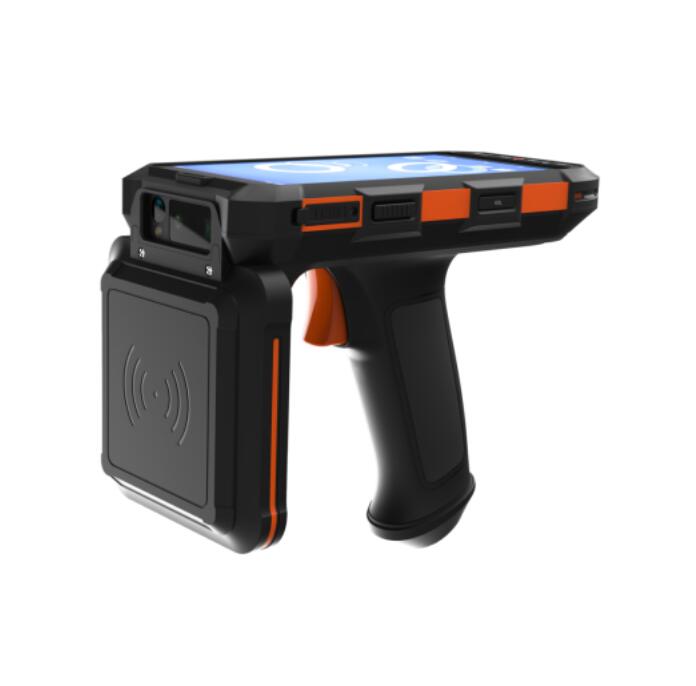
Recommended Tool for Searching: RFID Handheld Terminal
(1) Product Introduction
Boasting powerful capabilities—including UHF (Ultra-High Frequency) read/write functions, 1D/2D barcode scanning, and NFC read/write functions—this device offers excellent extensibility and superior sensitivity. This facilitates more precise and rapid data acquisition, as well as the efficient execution of necessary operational tasks. It runs on the latest Android 11 operating system, is powered by a high-speed 2.3GHz octa-core processor, and features an exceptionally long battery life.
(2) Product Features
1. Superior Performance: Supports the ISO 18000-6C protocol.
2. Convenient Development: Provides comprehensive development resources for both C# and Java.
3. Large Touchscreen Display: Features a 5.2-inch IPS high-definition screen.
4. Extended Battery Life: Equipped with an 8000mAh battery, offering a working duration of over 12 hours.
5. Ultra-Long Reading Distance: Capable of identifying RFID tags from a distance of over 10 meters.
6. High-Density Inventory Support: Offers high efficiency for inventorying multiple tags simultaneously in dense environments.
(3) Operational Workflow
When a specific item needs to be located, relevant item information can be entered into the RFID handheld terminal to initiate a scan within a designated area. Once the target item is detected, its exact location is automatically displayed on the handheld terminal’s screen. Simultaneously, the corresponding RFID-enabled shelf will activate a warning light to alert warehouse staff, enabling them to quickly identify the specific shelf where the item is stored.
IV. Benefits Realized
(1) The comprehensive solution provided by “Sike” has successfully transformed the traditional, rudimentary approach to warehouse management—which previously relied solely on manual counting for inbound/outbound operations and inventory checks—thereby significantly reducing the rate of errors. (2) It has significantly boosted the work efficiency of on-site personnel and reduced their physical workload, thereby realizing the objective of “leveraging technology to enhance labor productivity.”
(3) It ensures that warehousing data—including inbound/outbound records and inventory counts—possesses a high degree of real-time accuracy, precision, and connectivity, thereby greatly facilitating the sharing of information resources within the organization.
(4) By integrating advanced RFID technology, this warehouse management system has substantially elevated the enterprise’s level of modernization and digitalization, leading to enhanced economic benefits.
Post time: Jun-03-2026


