



Abstract
In the retail chain industry, inventory counting remains one of the most time‑consuming and error‑prone parts of operations management. Traditional counting relies on manual item‑by‑item barcode scanning. For a mid‑sized store, stocktaking often requires all staff to work overtime for hours after closing, resulting in low efficiency and high error rates.
While RFID technology has greatly streamlined inventory work, the market offers a wide range of UHF RFID handheld terminals with inconsistent specifications. Poor product selection frequently leads to issues such as insufficient reading range, severe tag missing reads and inadequate battery life, which significantly undermine inventory performance.
How should retailers select the right RFID handheld terminal for stocktaking? Taking the ST‑E7100 UHF Hand‑held Data Terminal as an example, this article outlines key selection criteria and real‑world performance to provide practical references for retail businesses.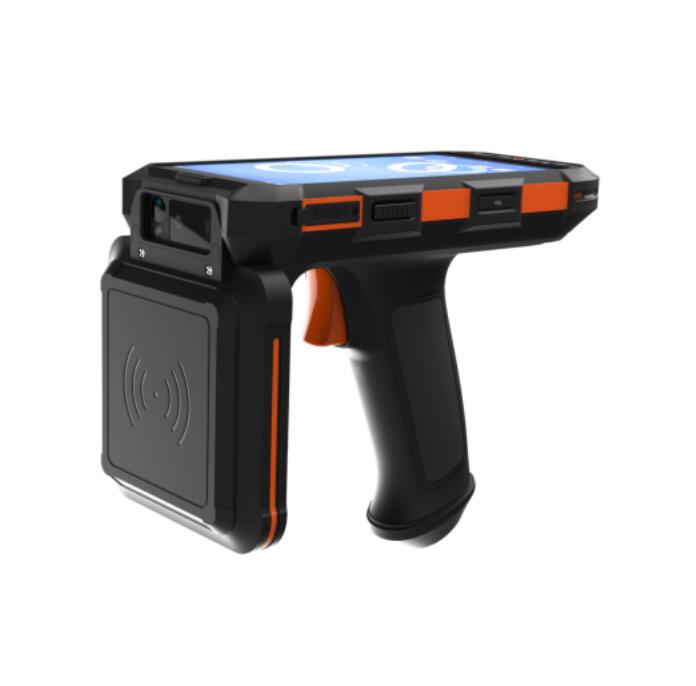
Four Core Selection Criteria for Retail Inventory RFID Handheld Terminals
Reading range to cover high racking and sales floor layouts
Retail stores feature both high shelving close to ceilings and floor displays. A limited reading range forces staff to climb ladders or scan at close quarters, hurting both productivity and workplace safety.
Multi‑tag reading capacity for densely tagged merchandise
Products are tightly arranged on retail shelves, with hundreds of RFID tags on a single rack. Slow multi‑tag reading means tags cannot be captured in one pass and requires repeated scanning.
Robust missing‑read resistance
Liquid goods such as beverages and metal‑packaged canned foods absorb and reflect RF signals, commonly causing missed reads. Anti‑missing‑read performance directly determines the accuracy of inventory data.
Battery endurance and ruggedness for full‑shift operations
Retail stocktaking usually takes place after store closing and lasts for hours. Devices must sustain continuous work through an entire shift and withstand frequent movement and accidental knocks on site.
How the ST‑E7100 Meets These Requirements
18+ Meters Long‑Range Reading: Cover High Shelves from Ground Level
The ST‑E7100 delivers ultra‑long reading distance up to 18 meters with instant response. Staff can scan high shelves while standing on the floor without climbing, boosting counting efficiency and eliminating fall hazards.
Bulk Read 1,000 Tags in 3 Seconds: Clear Dense Shelves in One Sweep
Featuring exceptional multi‑tag reading speed, the terminal can capture 1,000 tags within 3 seconds. It handles dense inventory and long‑distance bulk scanning effortlessly. Entire rack rows carrying hundreds of tags can be fully collected as staff walk past, drastically cutting stocktaking time.
Anti‑Missing‑Read Performance: Stable Performance Against Liquids and Dense Stacking
To address RF interference from liquid products like drinks, the device adopts highly optimized anti‑collision algorithms. It achieves reliable bulk counting without missing tags under complex conditions of dense stacking and tag signal collision, ensuring consistent book‑to‑physical inventory matching.
Long‑Lasting Power & Industrial‑Grade Ruggedness for Full‑Shift Stocktaking
Developed based on customer feedback regarding battery endurance, the ST‑E7100 is fitted with a high‑capacity replaceable battery to support prolonged continuous operation throughout a complete inventory shift. Spare batteries can be prepared in advance to avoid work interruptions due to low power. Its industrial rugged construction protects the unit against bumps and knocks in busy retail environments.
Typical Retail Store Application Scenarios
Sales Floor Shelf Inventory: Staff walk through aisles with the terminal and batch‑capture tags across entire shelf rows within seconds for fast stock reconciliation.
Warehouse Spot Checking: Bulk scan palletized goods in back storage without unpacking pallets for rapid inventory verification.
Inbound Receiving Check: Quickly scan tags on full cartons of incoming goods and auto‑match records against purchase orders.
Item Locating & Display Audit: Rapidly pinpoint target merchandise via RFID and verify whether goods are placed in compliance with display rules.
Post time: Oct-22-2026


